
Enniskillen & the Fermanagh Campaign, 1689 – A reappraisal
By Darren Graham
Tuesday 10th March, 7:30pm
Magee, Ulster University

Historian Darren Graham (PhD pending) has spent several years focused on researching the war in Fermanagh in 1689, and has seen publication in terms of:
‘The Irish Brigade, 1670–1745: The Wild Geese in French Service’ (Pen & Sword 2020)
‘Lord Mountcashel : the story of an Irish general’ (Pen & Sword 2019)
‘Brothers in Arms: The Hamiltons in Ireland, England and France 1610-1719’ (Pike & Shot Society 2012)
‘James FitzJames, Duke of Berwick’ (Pen & Sword, pending 2026)
He has conducted both academic and field based research in Fermanagh; his interests focus upon highlighting the importance of the 1689 campaign in Fermanagh, and setting it in context with the siege of Derry, including an examination of the notables involved and aspects of local folklore that remain hidden, unexamined, or even controversial.
He has previously lectured on this topic to the Irish Military History Society and various Fermanagh Historical Societies, though in this lecture will be presenting new information, recent archaeological findings, drone survey data and informed opinion.
Join us for a re-examination of the war in Fermanagh, the Enniskilleners’ war against the Jacobite Army and the legends surrounding Crom Castle, in terms of how these forgotten events sit alongside the lore of Derry in 1689.’
This event is kindly supported by Ulster University and the Department for the Economy.
Free Event, but booking your place is essential through the link below!
To Book tickets, Click on this Link: https://www.eventbrite.co.uk/e/enniskillen-the-fermanagh-campaign1689-a-re-appraisal-bydarren-graham-tickets-1982700272889?aff=oddtdtcreator
“Elagh Castle –Archaeological Dig”
by Cormac McSparron
Wednesday 22nd April 2026, 7pm (Verbal Arts Centre)

The Friends of The Derry Walls are delighted to announce that their April lecture is by Archaeologist Cormac McSparron and is titled “Elagh Castle Archaeological Dig”.
Cormac will talk about his extensive dig at Elagh Castle. Elagh Castle, also known as Docherty’s Tower, survives as a partially collapsed masonry tower constructed upon a rocky outcrop overlooking the city of Derry / Londonderry and the Pennyburn depression to its west.
It was in the 15th and 16th centuries the main castle and residence of the O’Docherty’s, although it is unlikely that they were the castle’s builders. It is probable that the existing remains were built in the 14th century before the O’Docherty’s held Inishowen. An excavation was carried out at Elagh Castle in 2013 by the Centre for Archaeological Partnership in partnership with the Northern Ireland Environment Service as part of the Derry / Londonderry City of Culture celebrations.
Cormac’s excavation’s revealed an Early Medieval outer rampart beyond the later Medieval castle, evidence for Early Medieval glass working, robbed out walls and floor platforms within the perimeter of the later Medieval castle, and foundations of a large structure of uncertain type to the north, which may have been part of an enclosure wall or bawn around the later Medieval castle.
The results of the excavation, and the chronological information it provided, demonstrated that the remains which we can see today are simply the last phase of a long period of activity at Elagh Castle stretching back to the Early Medieval Period, and beyond into the Iron Age. This supports the arguments made by a number of prominent historians and archaeologists that Elagh Castle is likely to have been Aileach, the capital of the Cenél nEógain, one of the most important royal sites of Ireland.
This event will take place at the Verbal Arts Centre, Bishop Street, Derry at 7pm on Wednesday 22nd April.
Tickets available now at: https://www.eventbrite.co.uk/e/elagh-castle-archaeological-dig-tickets-1982706912749?aff=oddtdtcreator
“History of St Columb’s Park House”
by Grace Nelis, Project Leader St Columb’s Park House
Tuesday 19th May 2026

Grace Nelis, Project Leader St Columb’s Park House will give a talk about the fascinating history of this iconic building, right up to the present day, as a place of healing.
“An Insight into the Derry ~Londonderry on the North Atlantic (DNA) Museum”
by Margaret Edwards, DCSDC Museum Service Manager
Monday 15th June, 7pm, Tower Museum
FREE EVENT
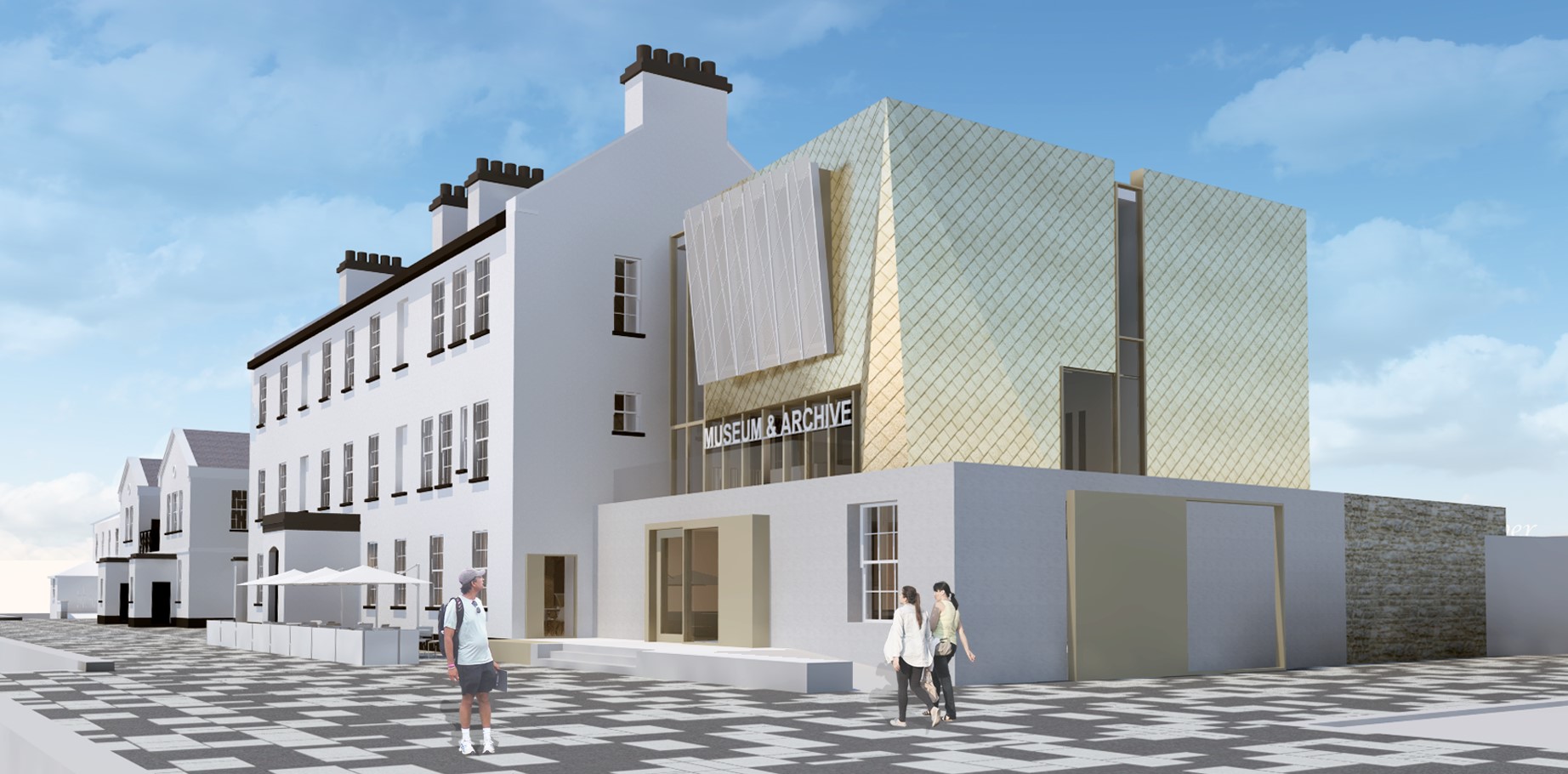
Margaret Edwards, DCSDC Museum Service Manager will give a talk about how work on the new DNA Museum is progressing. The DNA Museum will celebrate the city and wider district’s connection with the North Atlantic and how our unique global stories and people associated with here have shaped this place and created our distinctive personality.
PREVIOUS TALKS
“An insight into Derry City & Strabane District Council’s archive collections’
by DCSDC Archivist Bernadette Walsh.
Tuesday 10th February 2026

Bernadette will talk about the Council’s archive collection including significant collection from minute books to private collections to ephemera and art. Access and engagement opportunities, some exciting current projects and future plans for the DNA Museum.
410 years of change. – The Fabric of the Derry Walls
by Manus Deery
December 2025
Minor Hall, Magee, Ulster University

The Friends of The Derry Walls and Ulster University, Magee December 2025 lecture was given by Manus Deery, Director of the Historic Environment Division of DfC
This talk looked at the fabric of the monument that we see today. When was it actually built? What changes can be seen and what can’t? What do we know about all of this from the archives?
Manus Deery is an architect and Director of the Historic Environment Division of DfC- the state body who have looked after the fabric of the monument since 1955. He has been involved in the management of the monument since 2008.
This event was kindly supported by Ulster University and the Department for the Economy.
A Walk & Talk of The Derry Walls,
by Dr Liam Campbell.
Saturday 29th November

“The Walls in their watery landscape”. A Walk & Talk of The Derry Walls, by Dr Liam Campbell. This talk looked at the Walls in their relationships with both the Foyle and Swilly catchments and how this is constantly changing by both human and other factors. What we see now is not as it has always been and will not be in the future especially when we explore the nature of islands.
Launch Event: “Kilmallock-Derry-Bradford: Connecting Irish Walled Towns and UK Cities of Culture”
Tuesday, 25th November 2025

This event which was open to the public, showcased the exciting outcomes of an 18-month research project led by the University of Bradford in collaboration with University College Cork, which has created detailed 3D digital models of Derry’s Historic Walled City and Kilmallock.
The groundbreaking project has used cutting-edge digital twin technologies and geospatial survey methods, including geophysical prospection, terrestrial laser scanners, vehicle-mounted mobile mapping systems, and airborne capture, to create an immersive new web-based resource. Historic research has enriched these 3D datasets with detailed building biographies, combining architectural and archival research with invaluable local knowledge from individuals and community-based organisations. The result is a remarkable tool that enables 360-degree virtual tours and serves as a platform for preserving and sharing the historic narratives of our Walled City.
This project represents more than just technological innovation – it’s about community connection and forging strong linkages between two City of Culture cities, Bradford (UK City of Culture 2025) and Derry-Londonderry (UK City of Culture 2013). The collaboration demonstrates how our shared heritage can be preserved, celebrated, and made accessible through partnership and innovation. The project has been funded by the Arts & Humanities Research Council as part of UK-Ireland Collaboration in the Digital Humanities, and developed in partnership with Derry City and Strabane District Council and Limerick City & County Council, with assistance from the Friends of the Derry Walls. The new digital resource offers exciting possibilities for education, tourism, research, and heritage preservation.
The project was launched at Ulster University, Magee.
Ruairi O’Baoill – Derry Dig Director
The Big Dig Revisited!
Monday 12th May 2025, 7:30pm – 9:00pm
Venue: Magee, University of Ulster, Lecture Theatre MD108 (Old Building)

During September 2024, a very successful two-week community excavation, directed by Ruairí Ó
Baoill, took place in Derry City. The dig was part of the Centre for Community Archaeology (CCA),
Queen’s University Belfast’s CAPNI programme of community engagement with archaeology and
heritage. The programme is funded by a grant from the National Lottery Heritage Fund. The CCA’s community-based partners in the city were the Friends of the Derry Walls Queen’s had worked with the late Mark Lusby on excavations at Boom Hall and Lumen Christi and -as part of CAPNI- we were putting in place plans with him and Niall to return to the city to conduct the September excavation, before Mark’s untimely death in April 2024.
The CCA excavation was of a reconnaissance nature and took place just outside the historic 17th
century city walls at Nailor’s Row, between Double Bastion and Royal Bastion, to assess the
condition of the archaeological resource in this part of the city. Over the two weeks of the
excavation, more than one hundred adult volunteers and nearly two hundred school children from local schools participated in the dig under the supervision of the CCA archaeologists. The excavation uncovered interesting social history and material culture relating to life in this important Irish urban settlement over the last few centuries, with masonry remains and road surfaces dating back to the late-18th century being revealed. Artefacts retrieved include much Post-Medieval pottery (especially earthenwares), coins, clay tobacco pipes, metal work and personal effects such as buttons, styli, marbles and a holy medal. Although the excavation finished before reaching the level of the extra-mural ditch that once surrounded most of the 17th century city walls, artefacts from the period- 17th century English pottery from North Devon and Staffordshire and a lead musket ball- suggest that this important feature remains preserved safely under the ground for future archaeologists to investigate.
Ruairi returns to give us the low down on their dig. The dig itself generated much local, national and international publicity, at the time. Ruairi will go over their dig finds as well as set them into the context of our historic Walls and the history of Ireland.
Ruairí Ó Baoill
Ruairí Ó Baoill is an archaeologist with the Centre for Community Archaeology (CCA), Queen’s
University Belfast. He has more than 40 years field experience working on excavations all over
Ireland. Ruairí has served on the Board of the Institute of Archaeologists of Ireland (IAI), is a founder member and the first Chair of the Irish Post-Medieval Archaeology Group (IPMAG) and he was President of the Ulster Archaeological Society (UAS) from 2016-2022. Ruairí is the author of Island City: The Archaeology of Derry~Londonderry (2013) published by April Sky Design (Colourpoint Books) for the Northern Ireland Environment Agency: Built Heritage and Derry City Council.
Tickets Link: https://www.eventbrite.co.uk/e/the-big-dig-revisited-talk-by-ruairi-obaoill-derry-dig-director-tickets-1249713228909?aff=oddtdtcreator
Brónagh McAtasney – Northern Ireland Screen
The Walls of Derry In The Film Archives
Monday 7 April 2025, 7:00pm to 8:30pm

Northern Ireland Screen’s Digital Film Archive presents a collection of films on the Walls of Derry and stories of the city. Generations of filmmakers have captured the unique imagery of the Walls and the tales of the people who live around them. Come and see this exceptional screening of archive material.
The Digital Film Archive is a repository of films about and by the people of Northern Ireland and Ulster, going back 120 years. The online archive currently has over 2000 broadcasted and private, with many more added regularly. The films are presented by Access and Outreach Officer, Brónagh McAtasney from Northern Ireland Screen.
Date & Time: Monday 7 April 2025, 7:00pm to 8:30pm
Venue: Central Library, Foyle Street, Derry
Admission: Free event, no need to book!
This event and Friends of Derry Walls 2024/25 Programme is kindly sponsored by Inner City Trust
Archaeological Dig a great success!

Press Release – Oct2024
Now that the dust, or in this case, the dirt has settled after the recent archaeological dig beside our famous historic Walls, there is much anticipation in relation to what has been found. The dig, conceived by The Friends of the Derry Walls, and executed by the Community Archaeological Programme N.Ireland, Queen’s University, was kindly funded by the Heritage Lottery Fund.
Niall McCaughan, Chair of The Friends of the Derry Walls stated: “We are delighted with the success of our recent big dig, which has added much to the wider story of our historic city. When my late colleague and friend Mark Lusby first suggested the dig, never in our wildest dreams did we expect the interest that has been received locally, national and internationally. Mark had been very excited about it and it was a bittersweet moment that we recently lost him as the dig was about to start, but this dig is very much part of Mark’s huge legacy.
The dig really captured the interest particularly of the local population, and the dig team said to me that they were delighted with the interest shown by the local public to the dig; they stated that they always receive a huge welcome when they come to Northwest. We were fortunate to have a great turnout of local schools who took part in the dig as well as members of the public. In fact we were inundated and could not have facilitated all those who wanted to take part. There were many exciting finds and I am delighted that Ruairi will come back to Derry next May, and will give a lecture about his findings, as part of our Lecture Programme.
We would like to thank Ruairi and the team for coming to our city, and hope that they will return again in the future to continue their work. We would also like to thank Derry City Council for assisting in setting up the dig, The Verbal arts Centre for providing the space for our tour and exhibition, and finally to the various schools and members of the public who assisted over the dig. We have invited Ruairi to come back next Spring as part of our 2025 Programme to give a talk on his findings, once everything has been catalogued, reports written up, etc., which we are looking forward too”
Ruairí Ó Baoill, Centre for Community Archaeology site Director for the dig stated: “During September 2024, a very successful two-week community excavation took place in Derry City. The dig was part of the Centre for Community Archaeology (CCA), Queen’s University Belfast’s CAPNI programme of community engagement with archaeology and heritage. The programme is funded by a grant from the National Lottery Heritage Fund. The Derry excavation was directed by myself.
The CCA excavation was of a reconnaissance nature and took place just outside the historic 17th century city walls at Nailor’s Row, between Double Bastion and Royal Bastion, to assess the condition of the archaeological resource in this part of the city. Over the two weeks of the excavation, more than one hundred adult volunteers and nearly two hundred school children from local schools participated in the dig under the supervision of the CCA archaeologists. The excavation uncovered interesting social history and material culture relating to life in this important Irish urban settlement over the last few centuries, with masonry remains and road surfaces dating back to the late-18th century being revealed. Artefacts retrieved include much post-medieval pottery (especially earthenware’s), coins, clay tobacco pipes, metal work and personal effects such as buttons, styli, marbles and a holy medal.
Although the excavation finished before reaching the level of the extra-mural ditch that once surrounded the 17th century city walls, artefacts from the period- 17th century English pottery from North Devon and Staffordshire and a lead musket ball- suggest that this important feature remains preserved safely under the ground for future archaeologists to investigate.
The CCA’s community-based partners in the city were the Friends of the Derry Wall and its Chair, Niall McCaughan. Its founder, the late Mark Lusby, has been instrumental in promoting the heritage of the walled city.”
Note:
· The Friends of the Derry Walls is a voluntary organisation whose mission is to give a voice to the Walls, raising ambitions for their care and presentation, driving public engagement with the Walls and ensuring that the Walls are fully exploited as a resource for educational, cultural and economic development.
· For more information email Niall McCaughan at thederrywalls@gmail.com
· The Archaeological Dig was funded by a grant from The National Lottery Heritage Fun

Professor Jane Ohlmeyer
Did Ireland Have an Empire?
Friday 21st February 2025, 7:00pm – 8.30pm
Ireland was England’s oldest colony. How did the English empire actually function in early modern Ireland and how did this change over time? What did access to European empires mean for people living in Ireland? This talk answers these questions at a moment when events of the early twenty-first century – Brexit, ‘the culture wars’, the campaigns around ‘Black Lives Matters’ and ‘Statues must fall’ – along with calls for reparations and the restitution and repatriation of plundered artefacts have kindled a greater awareness of the importance of revisiting the history of empires. Booking details below.
Professor Jane Ohlmeyer is Erasmus Smith’s Professor of Modern History (1762) at Trinity College Dublin. She was a driving force behind the 1641 Depositions Project and the development of the Trinity Long Room Hub Arts and Humanities Research Institute. She chaired the Irish Research Council (2015-21). In 2023 received an Advanced ERC for VOICES, a project on the lived experiences of women in early modern Ireland. She is the author or editor of numerous articles and 13 books. Her latest Making Empire: Ireland, Imperialism and the Early Modern World (Oxford, 2023)is based on the 2021 Ford Lectures in Oxford. In 2023 she was awarded the Royal Irish Academy Gold Medal in the Humanities.
Breandán Mac Suibhne December 2024 lecture

The Friends of The Derry Walls is delighted to announce that their December 2024 lecture will be given by Breandán Mac Suibhne, Professor of Modern Irish History at the University of Galway. His lecture is titled ” What has happened to this house? Brian Friel and his Mother’s People”. Breandán will use the lives of the actual people on whom the characters in Dancing at Lughnasa are more or less based as the basis for a wide-ranging discussion of the history of west Donegall
Breandán Mac Suibhne is the author of The End of Outrage (2017), an award-winning book on land-grabbing and informing in the time of the Famine. He was a founding editor, with critic Seamus Deane, of the journal Field Day Review and several book series, and, with historian David Dickson, he edited The Outer Edge of Ulster (2020), the longest lower-class account of the Famine, by Hugh Dorian, a native of Fánaid who died in poverty in the Bogside in 1914. Mac Suibhne is Professor of Modern Irish History at the University of Galway.
The Lecture will take place on Wednesday 4th December at 7:30pm. Venue, Minor Hall, Magee, Ulster University. Venue for this lecture kindly hosted by Ulster University. Magee
Archaeology and Derry – a personal reflection by Brian Lacey
Wednesday 6th November, 7pm @ The Verbal Arts Centre, Derry

Brian Lacey’s first visit to Derry was on 5 November 1974. He was interviewed for and offered the job as an archaeologist at Magee College that same day. His career since then has been dominated by the archaeology and history of the city and its hinterland. In this talk for the Friends of the Derry Walls, Brian will reflect on his experiences over those 50 years.
This event and Friends of Derry Walls 2024 Programme is kindly sponsored by Inner City Trust
Nailor’s Row Excavation Site Tour and Artefact display
Saturday 14th September.
Join Queen’s University Centre for Community Archaeology Team and the Friends of The Derry Walls for a tour of the excavation site at Nailor’s Row, (off Orchard Row, Bishop Street) followed by a showcase of the archaeological finds from the recent dig beside Derry’s historic Walls, in the Verbal Arts Centre. This is a FREE event, and no booking is required. Just turn up at 11:30am at the dig site. Remember to wrap up!
• 11:30am – 12:30pm: Excavation site tour led by Ruairi O’Baoill, Dig Director. We will meet those attending the tour at the Nailor’s Row Dig Site, with the tour ending at the Verbal Arts Centre.
• 12:30pm: Artefacts display and project discussions with the CAPNI Team and Friends of the Derry Walls in the Verbal Arts Centre.
• 2:00pm: Finish.
This dig is kindly funded by the National Lottery Heritage Fund
Major Archaeological Dig Planned at Derry’s Walls

The Friends of The Derry Walls are delighted to announce that their much anticipated archaeological dig will soon be kicking off in Derry, when Queen’s University Community Archaeological Programme N.Ireland, moves on site in September.
Niall McCaughan, Chair of The Friends of the Derry Walls stated: “We are delighted that the big dig that we had been hoping for many years is finally here. In 1977 Brian Lacey carried out a dig near the Alexander House site just outside of Bishop Street, and at that time he found the remnants of a ditch. Since then, the late Mark Lusby Founder and Project Officer of The Friends of the Derry Walls wondered if in fact further evidence of a ditch around the Walls could be found and confirmed to be still in existence. In 2017 The Friends invited Queen’s University Archaeology down to do a short survey, and the grassy bank at Nailors Row was chosen as it was the largest open space around our famous historic Walls. Mark and I met the team at the time, and the Ground Penetrating Radar scan showed promising signs that these might indeed be something there. Since then, we had talked to Queens about the possibility of doing a full dig, and we were delighted that it was included in their 2024 programme. Mark had been very excited about it and it is bittersweet moment now that we recently lost him as the dig is about to start, but this dig is very much part of Mark’s huge legacy.
Last week I met Alastair Ruffell from Queens University who this time had with him a newer and more advanced Ground Penetrating Radar scanner with him, and on a wet Friday afternoon we scanned most of the bank, and again there are several promising anomalies. This is a very exciting project for all of us, the city and the island of Ireland, as we embark on an archaeological dig which will unfold more of the story of our one of Ireland’s most historic cities. If permissions are granted in full for the excavation, then the dig will take place in the second week of September. We are thankful for the Community Archaeological Programme N.Ireland for coming down to do the dig. There is huge interest in the dig nationally and internationally, as we all wait in anticipation on what might be uncovered.”
Ruairí Ó Baoill, Centre for Community Archaeology site Director for the dig stated: “This dig is part of the three-year Community Archaeology Programme Northern Ireland (CAPNI) programme of community archaeological activity being carried by QUB and funded by a grant from The National Lottery Heritage Fund. We are very exited about the proposed community excavation at Nailor’s Row. Our proposed archaeological investigation would be a reconnaissance excavation to assess the condition of the archaeological resource in this part of the city. The Thomas Raven map of the city in 1622 depicts a ditch surrounding the walled town, and this was identified on Fountain Street by Brian Lacey during an excavation carried out in 1977. It is possible that the features highlighted in the geophysical survey at Nailor’s Row may include this 17th century defensive ditch but they may also be related to other archaeological features-either from earlier or later periods- in this part of the city. Only excavation will reveal what these are. We might also get evidence of the houses and lives of Derry people who lived on Nailor’s Row in the 19th and 20th centuries. We are delighted to be working with The Friends of The Derry Walls in the city, and to assist them in helping to add to the wider story of this historic city.”
Notes:
· The Community part of the dig will take place for schools between 5th – 13th September, 10am-12noon each day.
· The Archaeological Dig is funded by a grant from The National Lottery Heritage Fund
· Youtube video explain GPR Scan – https://youtu.be/a5vvxGMM_Q4?si=Vf_pC3QgfDK_yRZz
Photo – Photo of Alastair Ruffell using the Ground Penetrating Radar Scanner beside the Derry Walls on August 2024 in preparation for the Big Dig

‘Limer-Derry’. Illustrated talk by Sarah McCutcheon, Archaeologist, Limerick City and County Council, on Limerick’s City Walls and the Siege of Limerick.
“An introduction to the evolution of Limerick City and its defences up to 1760 when it was declared an open city, and focussing on the final two sieges of 1690 & 1691″
Members get a 50% discount, at the door on the night!
This event and the rest of our 2024 Program is kindly sponsored by Inner City Trust
September Saturday 23rd 10.30-12.00

Take a Walk on the East Side.’ Walking tour around the rarely-visited, eastern flank of the Derry Walls. It will feature gates, bastions, tunnels, water, fires, theatres, and old maps. The tour will start at 10.30 in the entrance hall of the Verbal Arts Centre on Stable Lane. It will end at 12 noon in the Local Studies Section of Central Library on Foyle Street. The route will mainly be on public footpaths along city streets, but some peering through locked gates, over backyard walls and past parked cars may be required.
Tickets for the tour can be purchased here via Eventbrite or at the door. Walls Friends Members get a 50% reduction on all ticket prices. Tickets
The full programme of events for 2024 which is kindly sponsored by Inner City Trust can be downloaded below: